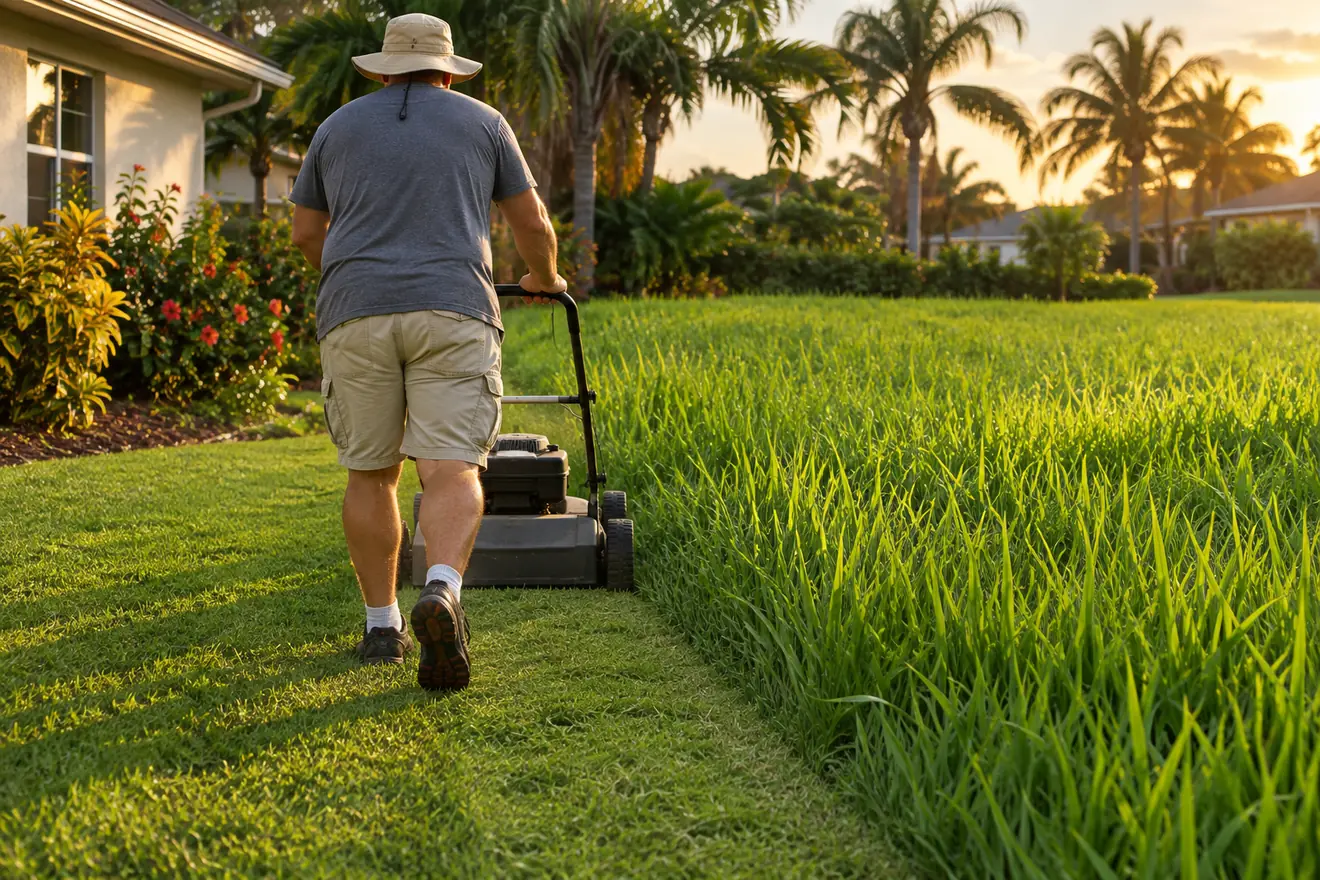
Lawn maintenance in Fort Myers comes down to four routines: mow St. Augustinegrass at about 3.5 to 4 inches and never remove more than a third of the blade, water only when the grass shows stress and apply roughly 1/2 to 3/4 inch at a time, follow the local fertilizer rules, and check the lawn regularly for pests, weeds and disease. Growth is fast in the hot, wet summer and slower in the cooler, dry months, so the schedule changes with the season.
Lawn mowing height in Southwest Florida
- Most St. Augustinegrass varieties do best mowed at about 3.5 to 4 inches; bahiagrass at about 3 to 4 inches. Mowing too short weakens the turf and invites weeds.
- Remove no more than one third of the leaf blade at a time. In summer that often means mowing every week; in winter, less often.
- Keep mower blades sharp. Torn grass tips turn brown and are more prone to disease.
UF/IFAS lists a wider range for St. Augustinegrass, 2.5 to 4 inches, with mowing every 5 to 14 days depending on growth, and says only dwarf cultivars such as Seville, Jade, Palmetto and Delmar should be cut below 3 inches. Its examples for other grasses are 3 to 4 inches for bahiagrass, 1 to 3 inches for zoysiagrass (reel mower) and 0.5 to 1.5 inches for bermudagrass (reel mower). The one-third rule means a lawn kept at 3 inches should be mowed when it reaches about 4 to 4.5 inches.
Mowing habits that protect the lawn
- Leave the clippings on the lawn; they break down quickly and return nutrients.
- Mow only when the grass is dry, and change direction each time to avoid wear patterns.
- Measure the cutting height from a flat surface such as the driveway rather than trusting the lever markings.
Not sure what grass you have? See grass types for Fort Myers lawns.
Watering a Fort Myers lawn
Water deeply and only when the lawn shows signs of need, such as folded leaf blades or footprints that stay visible. Watering in the early morning reduces evaporation and disease. Lee County and the cities set watering days and times, so check the current schedule and set the controller to match. More detail is in irrigation systems.
How much water per application
UF/IFAS says that in most Florida soils the correct amount is 1/2 to 3/4 inch per irrigation, with sandy soils at the higher end. To find out how long that takes, set 5 to 10 straight-sided cans (tuna or coffee cans) at random across one zone, run the zone for 15 minutes, and measure the depth in each can with a ruler. Averaging the depths gives your rate per 15 minutes; multiply by four for inches per hour. Do the same for each zone, because rates differ.
For normal maintenance UF/IFAS says only one program is needed for a normal two-day-a-week schedule and that irrigation can be cut back in the rainy summer and cooler winter months. Always follow the current Lee County or city watering days. Mulched beds and young plants have different needs; see mulch types, depth and timing.
Fertilizer
Lee County restricts nitrogen and phosphorus fertilizer during the summer rainy season to protect local waters, and municipalities may have their own rules, so check the current ordinance before you apply anything. Timing and products are covered in the lawn fertilization guide.
Weeds, pests and disease
A dense, properly mowed lawn crowds out many weeds. Chinch bugs, sod webworms and fungal disease are common problems here; identify the cause before treating. See weed control, lawn pests and lawn disease. A compacted or thatchy lawn also struggles to take up water and air, which is covered in lawn aeration and dethatching. If large patches are thin or dead, sod installation and aftercare explains replacing them.
Landscape maintenance beyond the lawn
Landscape maintenance in Fort Myers usually includes beds, shrubs and trees as well as turf. Trim and edge on a regular rhythm, keep mulch topped up, and cut back branches before storm season; see tree trimming and tree care and hurricane season landscape prep. Choosing plants suited to the climate lowers the work over time, as described in Florida-friendly landscaping.
Hiring a lawn service
Ask what each visit includes (mowing, edging, blowing, trimming), how often they come in summer and winter, whether fertilizer and pest control are included, and who holds the state license required to apply pesticides for hire. Also ask what mowing height they use; UF/IFAS says only dwarf cultivars should be cut below 3 inches, so a crew mowing standard St. Augustinegrass very short is a warning sign. Get the schedule and price in writing.
Frequently Asked Questions
How often should I mow my lawn in Fort Myers?
Mow often enough that you never remove more than a third of the blade. UF/IFAS gives 5 to 14 days for St. Augustinegrass, with the shorter interval during fast summer growth and the longer one when growth slows.
What is the best mowing height for St. Augustinegrass in Southwest Florida?
About 3.5 to 4 inches for standard varieties. UF/IFAS gives 2.5 to 4 inches overall and reserves cuts below 3 inches for dwarf cultivars such as Seville and Jade.
How much should I water my lawn?
Apply about 1/2 to 3/4 inch per irrigation, and only when the grass shows wilt stress. Measure your sprinkler output with cans so you know the run time, and follow the current watering days for your address.
Should I bag or leave the grass clippings?
Leave them. UF/IFAS notes that clippings break down quickly and return nutrients. If they clump, rake them or mow again to spread them out.