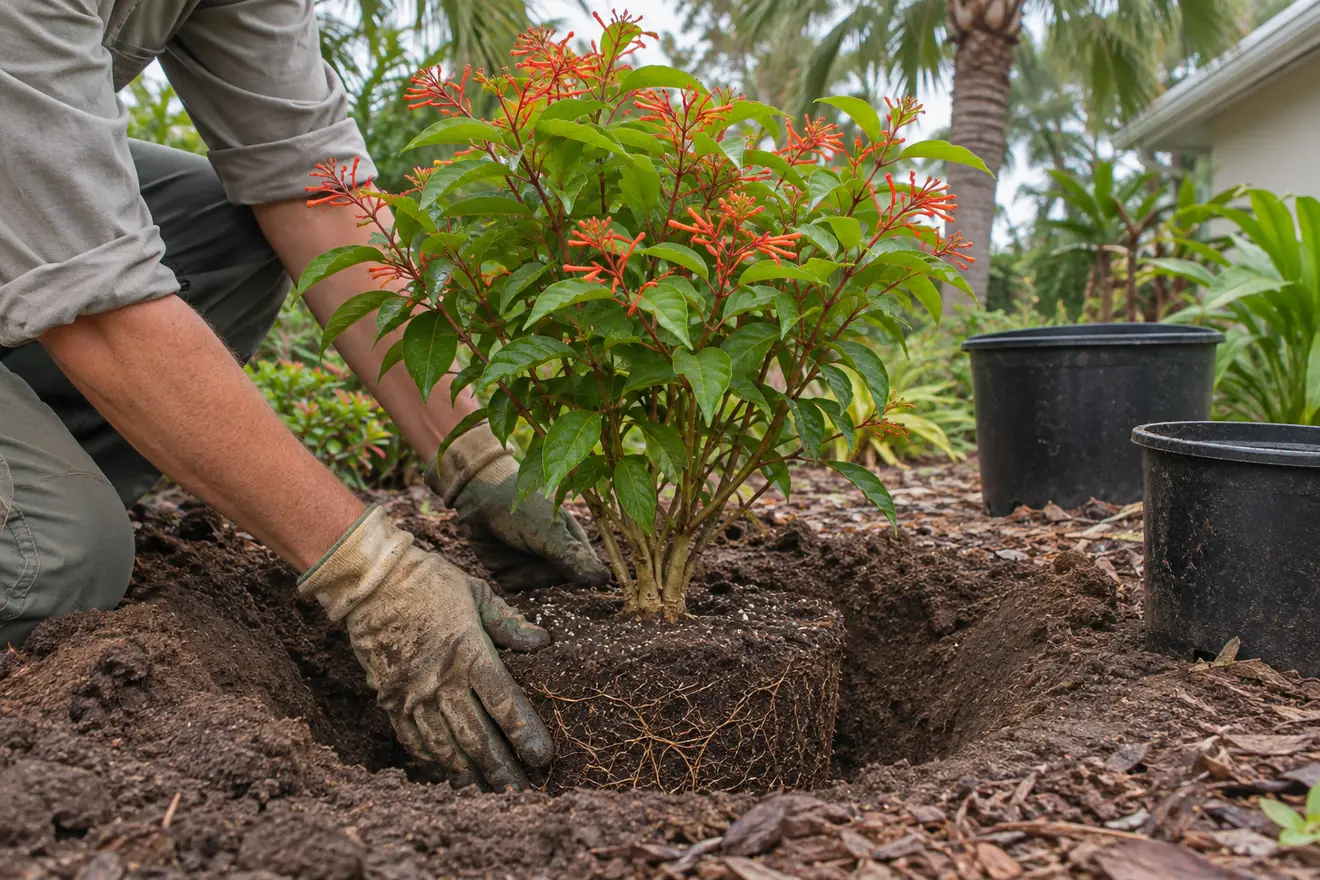
To plant shrubs, trees and palms in Fort Myers, set the root ball so the top of the root flare sits at or slightly above the surrounding soil, backfill with the native soil, mulch without touching the stem, and keep watering on a taper for months, not weeks. Planting too deep and ending watering too early are the two mistakes this page is built to prevent.
This page covers the planting and establishment steps. For what to plant, use the plant guide, which lists palms, shrubs and annuals commonly used in Southwest Florida.
Plan before you dig
- Match the site. Check sun, shade, soil moisture and salt exposure for each bed, then choose plants that suit those conditions. The Florida-friendly landscaping approach starts from the same idea: the right plant in the right place.
- Think about mature size. Shrubs and palms planted too close to the house or to each other end up needing constant trimming. UF/IFAS advises keeping the center of a shrub more than 2.5 feet from the foundation, and spacing shrubs in a group so they touch only once they reach mature size.
- Mix permanent and seasonal plants. Shrubs, ground covers and palms form the structure; annuals add seasonal color.
- Check drainage. A bed that stays soggy after summer storms will drown plants that tolerate dry sandy soil. See yard drainage solutions before planting a low spot.
How deep to plant: the root flare rule
Setting the plant too deep is a common planting mistake. Plant at the same depth the plant grew in its container; planting too deep is a common cause of decline. UF/IFAS says the flare of a shrub or tree should always be above the surface of the landscape soil. If the flare ends up buried, lift the plant out, add soil to the bottom of the hole and set it again.
How to plant a shrub
- Dig the hole at least one and a half times as wide as the root ball and one to two inches shallower than it, so the top of the ball sits slightly high.
- Soak the root ball and the hole thoroughly.
- If the plant is very root-bound, slice the outer edge of the root ball in several places or loosen the perimeter by hand.
- Backfill around the sides only. Do not pile soil over the top of the root ball.
- Mulch, keeping it at least 2 inches from the base of the shrub.
How to plant a tree
- Dig a hole two to three times as wide as the root ball. UF/IFAS gives no fixed depth; the trunk flare should sit at or slightly above the soil surface.
- Remove roots that circle close to the trunk and shave off the outer inch or so of the root ball, so those roots cannot later strangle the trunk.
- After backfilling, the top of the root ball should sit about an inch above the surrounding ground, and the tree should stand level.
- Soak the root ball and hole at planting.
- Stake if necessary, such as for a top-heavy tree or a windy site, and remove stakes within a year.
For shaping the young tree and later pruning, see tree trimming and tree care. The hurricane season landscape prep page covers the storm side.
How to plant a palm
Palms follow the same rule on depth: plant at the exact depth the palm grew in its previous container. According to UF/IFAS, container-grown palms can be planted at any time of year, while field-grown (dug) palms do best when planted in early summer, when soil is warm and rain is frequent. Water frequently during the first few months, then fertilize four times a year with a palm fertilizer. Expect little visible growth the first year, because the palm puts its energy into roots. Palms have their own care needs, including nutrition and careful pruning; see palm tree trimming and care.
How often to water new plantings
Water new plants frequently until roots grow into the surrounding soil, then taper off. Summer rains help, but dry spells still need attention. UF/IFAS gives these starting points:
- Shrubs (3-gallon size), south of Orlando: about 1 gallon every 4 days, applied to the root ball, ideally before 10 a.m. Establishment takes roughly 20 to 28 weeks; after that, UF/IFAS recommends waiting for signs of wilting before irrigating.
- Trees planted in spring or summer: water two to three times a week for the first few months, then weekly until established. Use 2 to 3 gallons per inch of trunk diameter, so a 2-inch tree gets 4 to 6 gallons each time.
- Palms: frequent watering for the first few months; UF/IFAS gives no exact interval.
Hand watering may be the only way to follow this schedule and still comply with local water restrictions, which are explained on the watering restrictions and irrigation page.
Mulch around new plantings
Add a layer of mulch around new plantings, keeping it away from stems and trunks. UF/IFAS recommends 2 to 3 inches over the bed; for a newly planted tree, spread 3 inches deep in a circle at least 8 feet across and keep it 12 inches from the trunk. Keeping mulch off the trunk helps prevent rot.
Seasonal color, hedges and special settings
Southwest Florida's planting calendar is unlike the north's. Many flowers grown as summer annuals up north do better here in the cooler months, while heat-tolerant plants such as pentas, vinca and salvia handle summer. See seasonal color planting for timing. For screening, read privacy hedges and screening plants. Planting around a pool or in a salt-exposed yard has extra constraints; see pool landscaping and tropical landscaping.
If you hire a company
Ask for a written list of plants with their container sizes, the planting price and whether any warranty applies if a plant fails to establish, and how watering will be handled during establishment. Check that the quote describes planting the root flare at or above grade and mulch pulled back from stems.
Frequently Asked Questions
How deep should I plant a shrub or tree?
The root flare, where the trunk widens at the top of the roots, should sit at or slightly above the surrounding soil. UF/IFAS says to dig a shrub hole one to two inches shallower than the root ball and to set a tree root ball about an inch high after backfilling.
How long does it take for a new shrub to establish in Southwest Florida?
UF/IFAS puts shrub establishment at roughly 20 to 28 weeks, with watering of a 3-gallon shrub about every 4 days south of Orlando. After that, water only when the plant shows wilting, within local restrictions.
Should I stake a newly planted tree?
Stake if necessary; UF/IFAS notes top-heavy trees, especially in windy locations, may need it. Stakes should be removed within one year of planting.
Can I plant a palm in summer?
Yes for container-grown palms, which UF/IFAS says can be planted any time of year. Field-grown palms are best planted in early summer, when soil is warm and rain is frequent.
How much mulch should go around a new plant?
Two to three inches deep over the bed, according to UF/IFAS Florida-Friendly Landscaping, pulled back at least 2 inches from shrub stems and 12 inches from the trunk of a newly planted tree.
Sources: UF/IFAS Gardening Solutions pages on planting shrubs, planting and establishing trees and planting palms; UF/IFAS Florida-Friendly Landscaping mulch principle.