Fort Myers receives between 54 and 60 inches of rain most years - roughly 50 percent more than Chicago typically sees - and roughly 60 to 65 percent of it falls in a four-month window from June through September. Much of Lee County sits less than 10 feet above sea level. The water table is close to the surface. When those three facts combine, standing water in residential yards is not bad luck. It is the built-in condition that drainage infrastructure exists to overcome. Hurricane Ian made that structural reality impossible to ignore when storm surge exceeding 12 feet inundated parts of Fort Myers Beach in September 2022, exposing pre-existing drainage failures across thousands of yards that had never been properly graded.
Why Fort Myers Yards Flood: The Climate and Terrain Behind the Problem
The problem starts underground. Across most of Lee County, the seasonal high water table sits just a few feet below grade and rises even closer to the surface after sustained rainy-season events. That limits how deep drainage pipes can realistically be installed - a physical constraint that shapes every solution available on Southwest Florida residential lots.
Above ground, the terrain provides almost no help. Most Fort Myers lots have barely measurable natural slope. Rain that falls here has nowhere to go quickly. When soil reaches saturation - which happens fast during back-to-back summer storms - any additional rainfall becomes surface runoff with no clear path off the property.
August is the single wettest month of the year in Fort Myers. The rainy season does not spread its rainfall evenly; it delivers short, intense bursts that overwhelm soil absorption. The day after the ground is already saturated from the previous storm, even a moderate afternoon event produces standing water.
Hurricane Ian exposed the depth of the problem. Properties that had survived typical rainy seasons without obvious flooding were revealed as badly under-graded once sustained surge and rainfall combined. For many Fort Myers homeowners, Ian was the moment drainage stopped being a deferred maintenance item and became urgent work.
Five Warning Signs Your Yard Has a Drainage Problem
- Water standing more than 24 hours after rain. On a properly graded lot, surface water moves toward the swale and drains within a few hours. Persistent pooling the following morning is a direct indicator of drainage failure - not a heavy rain anomaly.
- Turf dying in the same low spots each season. Recurring dead patches in lawn depressions are almost always a drainage problem presenting as a lawn disease. The disease is real; the drainage failure is what causes it.
- Mulch washing out of beds after storms. When mulch migrates consistently in one direction, water is moving fast enough across the surface to carry material. That velocity points to a grade that is sending runoff the wrong way.
- Foundation or garage dampness without a plumbing source. Surface water pooling against a home's perimeter eventually finds its way through. Persistent dampness along exterior foundation walls is often a yard drainage issue first.
- Pooling on the lanai or pool deck after every storm. A flat concrete surface with no positive drainage path collects water at its lowest point with nowhere to exit - a point-source problem that a catch basin or regraded surface inlet is built to solve.
The Five Drainage Solutions and What Each One Does
French Drains
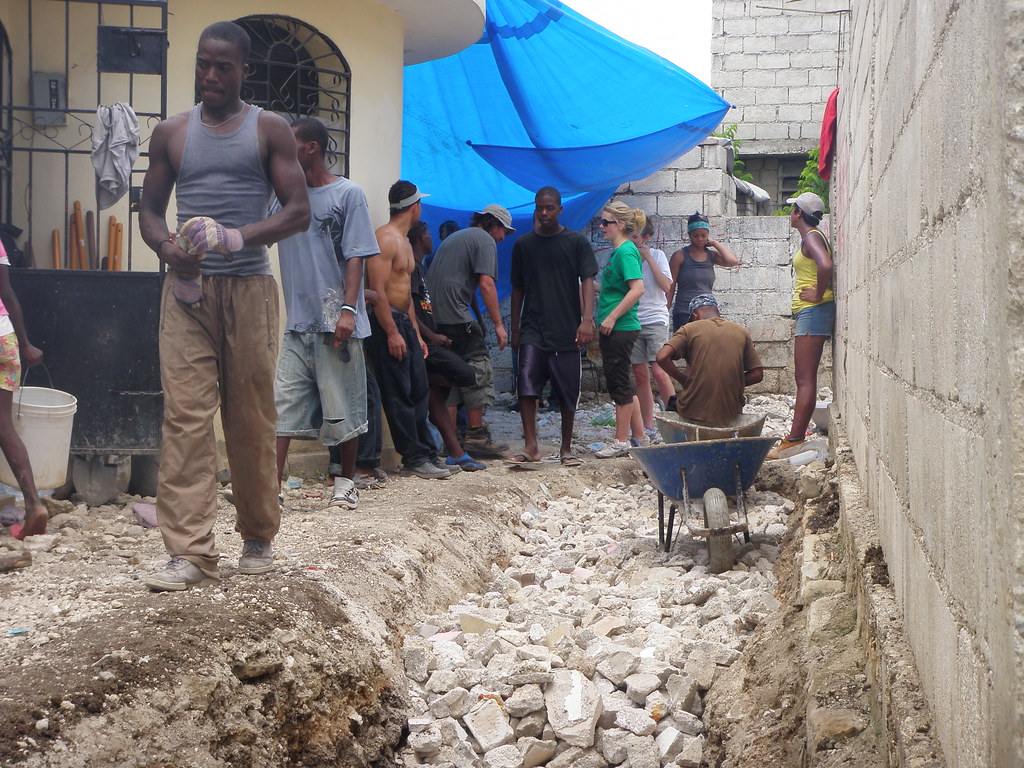
A French drain is a perforated pipe set in a gravel-filled, filter-fabric-lined trench. Water seeps into the gravel, enters the pipe, and travels to a discharge point - a swale edge, a catch basin, or daylight at the property line. In Southwest Florida, the shallow water table limits how deep these pipes can go, but a correctly designed French drain handles surface and near-surface water effectively. Costs vary by depth, pipe diameter, and total run length; get written, itemized quotes from licensed contractors before agreeing to any number.
Swale Grading and Reshaping
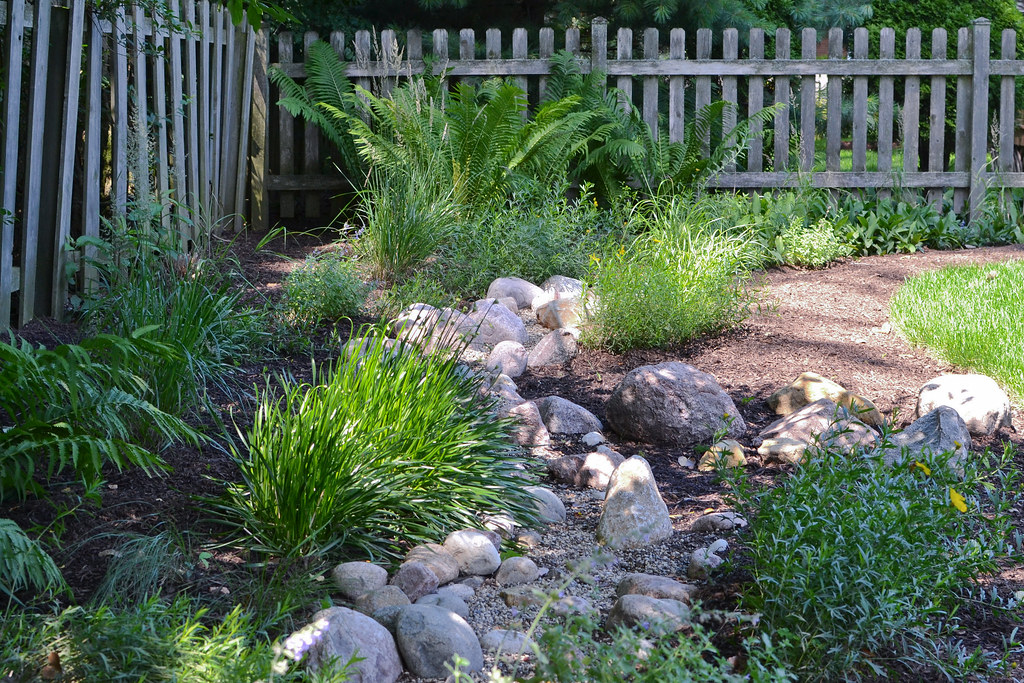
A swale is a shallow vegetated channel that carries runoff toward a stormwater inlet or retention area. Most Fort Myers lots already have a roadside swale; the problem is often that the interior yard grade does not direct water toward it. Reshaping or extending a swale is typically the most cost-effective first move on flat lots. A well-built vegetated swale also slows water velocity, promotes infiltration, and filters pollutants before runoff leaves the property.
Catch Basins
A catch basin is a grated surface inlet connected to underground pipe that carries collected water to a discharge point. It solves point-source pooling - the low corner of a driveway, a pool deck depression, a patio that sits below surrounding grade. It handles specific, localized collection points where regrading the surface is impractical. It does not fix yard-wide drainage failure.
Downspout Diversion
Roof drainage contributes enormous volumes of water per storm, and if downspouts discharge against the foundation or onto a patio edge, they create concentrated pooling before a drop of rain touches the lawn. Downspout extensions and buried emitters that carry roof water to the swale are low-cost, high-impact fixes - sometimes the only intervention a yard needs before the remaining drainage problems disappear.
Lot Regrading
When problems are systemic - water pooling in multiple areas, grade sloping toward the house, no defined drainage path anywhere - regrading the entire lot is the correct base-level solution. Fill is imported, positive slope away from structures is established, and drainage routes are defined. On FEMA flood zone properties, fill placement must account for base flood elevation requirements, which adds engineering cost. Regrading is the most expensive option and the most foundational; everything else performs better when the grade underneath it works.
Matching the Right Solution to Your Specific Yard
The wrong drainage structure does not fail slowly. It can redirect water toward structures or stall entirely during peak season, making the original problem worse. The decision starts with identifying the actual failure type.
- Slow percolation with a high water table: A French drain needs a hydraulic gradient - somewhere lower for water to move toward. When the seasonal water table rises near or above the pipe invert, that gradient disappears. Assess soil percolation and water table depth before specifying underground pipe as the primary fix.
- Flat grade with no surface path to the street: Swale regrading or lot regrading addresses this directly. Adding underground pipe without fixing the grade leaves the root cause in place.
- Isolated low spot at a hard surface: A catch basin with a pipe run to the swale is the right tool. Regrading a poured concrete deck is rarely practical or cost-effective.
- Concentrated discharge from downspouts: Fix roof drainage first. It is the lowest-cost intervention and may eliminate the need for more extensive work.
- Multiple failure points across the yard: Properties with systemic grading problems plus point-source pooling typically need a combined approach - regrading first, then drainage structures over it. A professional site assessment determines the correct sequence.
How Standing Water Destroys Your Lawn and Landscaping
St. Augustine Grass and the 48-Hour Window
St. Augustine is the dominant lawn grass in Fort Myers, and it has limited tolerance for waterlogging. Root damage and fungal infection begin when water stands for more than 24 to 48 hours. Pythium root rot - directly linked to soil saturation - is one of the most common lawn diseases in Southwest Florida. The lawn may look green for several days after a flooding event, then collapse rapidly as root damage catches up. By the time the turf is visibly dead, the window to prevent it has long passed.
Landscape Plants and Crown Rot
Most ornamental plants used in Fort Myers landscapes tolerate periodic wet-dry cycles but not prolonged saturation at the crown. Crown rot sets in when a plant's base sits in wet soil for days, blocking oxygen from the root zone. The UF/IFAS Florida-Friendly Landscaping program promotes matching plants to site water and light conditions, an approach that can substantially reduce irrigation demand - but those potential savings are irrelevant if the yard's drainage fails and drowns the plants chosen specifically for water efficiency. Contact your local UF/IFAS extension office for guidance on plant selection suited to your specific site.
The Re-Sod Bill Nobody Anticipates
Bahia grass, a more durable alternative to St. Augustine, can survive submersion for 7 to 10 days under moderate water temperatures, but young or drought-stressed Bahia plants fail faster. When drainage failure kills a lawn, the repair is not simply buying new sod. The drainage problem must be identified and corrected first, the soil must dry adequately, and regrading may be needed before sod can be installed. An unresolved drainage problem kills the replacement sod in the same spots, for the same reason.
Lee County and SFWMD Permit Rules: What You Must Know Before You Dig
Lee County DOT Swale Permits
Lee County's Department of Transportation requires a permit to pipe, block, or otherwise modify a public right-of-way swale. Unpermitted swale piping is a code violation, and enforcement can require removal of the work at the homeowner's expense. Piping a swale for easier driveway access without a permit is a common shortcut that catches up with homeowners during property sales or post-storm inspections. Contact Lee County DOT directly before any work begins in the right-of-way to confirm current permit requirements and start the application.
When SFWMD Review Is Required
If a drainage modification connects to the public stormwater system, or if the property falls within a FEMA flood zone (AE, AH, or VE), South Florida Water Management District permitting is likely required in addition to the county permit. The SFWMD also requires a minimum separation between the bottom of any stormwater retention feature and the seasonal high water table - a rule that directly limits how deep French drain discharge points and dry wells can be placed on low-lying Fort Myers lots. Verify current SFWMD requirements before finalizing any drainage design; the threshold governs what is physically and legally buildable on your specific lot.
FEMA Flood Zone Complications
Properties mapped primarily as Zone X can still have rear-yard or pool-deck areas that cross into Zone AE, affecting where drainage structures can be legally placed and what engineering documentation is required. Any drainage project on a Lee County property should include a FEMA Flood Insurance Rate Map check before design begins - not after permits are pulled.
What a Professional Drainage Assessment Evaluates
A contractor who walks the yard for five minutes and proposes a French drain without any measurements is guessing. A proper drainage assessment for a Fort Myers residential lot involves steps that cannot be skipped without compromising the design.
- Soil boring and percolation testing - identifies subsurface material and how quickly water moves through it, determining whether underground drainage is viable or whether the soil will simply hold water
- Seasonal high water table depth - sets the hard limit on pipe depth and dry well feasibility; on a lot where the water table rises within a couple feet of the surface at peak rainy season, pipe depth is a hard constraint
- Slope measurement across the lot - a laser level or digital transit documents actual grade in multiple directions; on nearly flat terrain, eyeballing is not sufficient
- Existing infrastructure check - underground utilities, buried irrigation lines, existing drain pipes, and septic proximity all constrain where new structures can be placed
- FEMA flood zone verification - confirms whether zone boundaries cross any part of the lot, including rear areas that may carry different designations than the front
Cost Guide for Fort Myers Drainage Projects
Drainage costs in Fort Myers span a wide range depending on which solution the yard actually needs, the site conditions, and whether flood zone status triggers additional engineering or permitting. French drain systems are priced per linear foot, and a residential installation can total anywhere from a few thousand dollars to significantly more depending on depth and total run. Catch basin systems scale with the number of inlets and the pipe run to discharge. Complete lot regrading and drainage overhauls represent the largest investment - and costs climb further on FEMA flood zone properties where fill placement must satisfy base flood elevation requirements.
Several factors consistently push costs higher on Fort Myers projects:
- Location within a FEMA flood zone, which often requires engineering review and SFWMD permitting beyond the standard county permit
- A high seasonal water table that limits pipe depth and eliminates dry well options, sometimes forcing a longer discharge run to daylight
- Existing hardscape - driveways, pool decks, patios - that must be cut, worked around, or restored after underground pipe is installed
- Properties requiring both surface regrading and underground drainage as a combined system rather than one approach alone
Ask for written, itemized quotes that specify pipe size, depth, materials, discharge method, and whether permit fees are included. A vague per-project quote without line items makes it impossible to compare contractors or verify what the work actually covers.
Drainage as Part of the Bigger Landscape Picture
Drainage is the foundation layer of any landscape renovation, not an optional add-on. The correct sequence is: establish grade, install drainage structures, then lay sod, build planting beds, and apply mulch. When that order is reversed - sod installed before the grade is corrected, beds planted before drainage is addressed - every element that follows performs below its potential and often fails outright.
Mulch applied over a poorly drained bed traps moisture at the root zone of plants already stressed by saturation. Sod installed on unresolved drainage pooling will die in the same spots for the same reasons, no matter the grass variety. A contractor who treats drainage as an integrated step designs planting bed locations to work with the way water moves across the property - so the entire yard functions through a Fort Myers rainy season, not just the week after installation.
Frequently Asked Questions
How long can water stand in my Fort Myers yard before it kills the grass?
St. Augustine grass - the dominant lawn type in Fort Myers - begins showing root damage and becomes vulnerable to Pythium root rot when water stands for more than 24 to 48 hours. The visible collapse of turf can come days later, after root damage has already progressed. If the same low spots stay wet for more than two days after a storm, treat it as an active drainage failure rather than a temporary inconvenience.
Do I need a permit to pipe a swale or install a French drain in Fort Myers?
Any modification to a public right-of-way swale requires a Lee County DOT permit - unpermitted work is a code violation and can be required to be removed. If the drainage connects to the public stormwater system or the property is in a FEMA flood zone (AE, AH, or VE), South Florida Water Management District review is also likely required. Contact Lee County DOT and verify the property's FEMA zone designation before any work begins.
Why would a French drain stop working during rainy season?
A French drain moves water by hydraulic gradient - toward a lower discharge point. When the seasonal water table rises near or above the pipe invert during peak rainy season, that gradient disappears and the system stalls. This is exactly why soil boring and water table depth testing should precede any French drain design on a low-lying Fort Myers lot, not follow it.
What triggers South Florida Water Management District review on a residential drainage project?
SFWMD involvement is typically triggered when a drainage modification connects to the public stormwater system or when the property falls within a FEMA flood zone. The SFWMD also regulates the minimum separation between stormwater retention features and the seasonal high water table - a rule that limits the depth of drainage structures on many Southwest Florida lots. Verify current thresholds directly with SFWMD before design work is finalized.
What is the correct order for a landscape renovation that includes drainage work?
Grade and drainage always come first. Sod, planting beds, and mulch follow only after drainage structures are in place and verified. Installing plants or grass before resolving drainage problems means those investments will fail in the same problem areas for the same reasons - and the drainage repair still has to happen before anything can grow successfully in those spots.
How do I know if my yard needs regrading versus a French drain?
Regrading addresses the cause when the fundamental problem is that water has no path away from the yard or is actively sloping toward the house. A French drain addresses the symptom - water that has collected somewhere and needs to be moved underground to a discharge point. Many Fort Myers properties with multiple drainage failures need both: regrading to establish correct surface flow, and underground pipe to handle water that still collects in low areas after the grade is corrected. A soil boring and slope measurement will tell a contractor which problem your yard actually has.