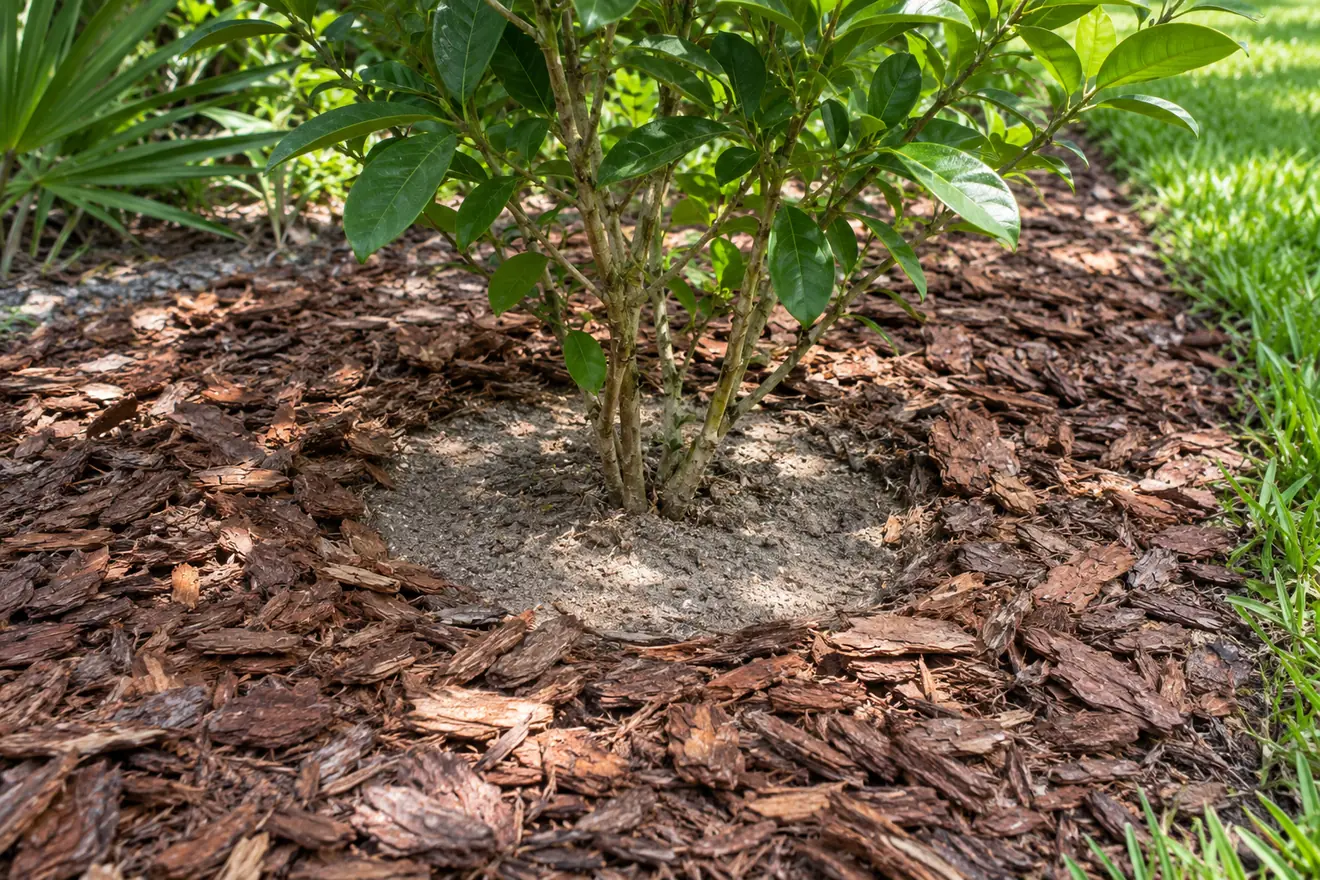
For most Fort Myers beds, spread 2 to 3 inches of organic mulch, keep it pulled back from trunks and stems, and top it up when it thins out. In Southwest Florida's sandy soil and strong sun, mulch holds moisture, keeps roots cooler, slows weeds and reduces soil washing away in heavy rain.
How much mulch to use and where to put it
- A layer of about 2 to 3 inches is enough for most beds. The University of Florida's Florida-Friendly Landscaping program recommends a 2- to 3-inch layer on plant beds, and UF/IFAS Gardening Solutions says coarse materials such as pine nuggets can go to 4 inches but should not build up beyond that. Deeper layers can keep rain, irrigation and air from reaching roots.
- Keep mulch a few inches away from tree trunks and shrub stems. Mulch piled against trunks holds moisture against the bark and invites rot and pests. Florida-Friendly Landscaping advises at least 2 inches of clear space around trunks, while UF/IFAS Gardening Solutions suggests at least 12 inches from the trunk of woody plants, which also reduces damage from mowers and trimmers. A wider ring is the safer choice.
- Top up rather than replace: organic mulch breaks down over time and usually needs refreshing about once a year. Raking matted mulch lets water and air through and makes it look fresh again.
- If mulch is used over a tree's root ball, Florida-Friendly Landscaping guidance for professionals says to keep it to a thin layer, 1 inch or less.
Types of mulch
| Type | Notes |
|---|---|
| Pine bark | Common, attractive, breaks down slowly; small nuggets can float away in heavy rain. |
| Pine straw | Light, easy to spread, stays put on slopes; needs topping up more often. |
| Eucalyptus and melaleuca | Made from farmed or invasive trees; often suggested as alternatives to cypress. |
| Cypress | Widely sold; Florida-Friendly Landscaping guidance suggests choosing renewable alternatives. |
| Rubber and rock | Do not break down or feed the soil; rock also holds and radiates heat. |
Which mulch is best for Southwest Florida beds?
Organic mulch gives the most benefit because, as it decomposes, it improves soil fertility, structure and drainage, according to UF/IFAS Gardening Solutions. Florida-Friendly Landscaping lists melaleuca, pine straw and eucalyptus as good choices when sustainably harvested, and does not recommend cypress because it may not be harvested sustainably. Under trees, fallen leaves left in place work as free mulch.
In practice, pick by the job. Pine straw suits sloped or informal beds. Heavier bark or wood chips suit flat beds that are seldom disturbed. Rock and rubber suit places where no planting will ever happen, since they add nothing to the soil. For a native-plant bed, see Florida-Friendly Landscaping in Fort Myers.
How many bags or cubic yards do you need?
The arithmetic is simple. One cubic yard is 27 cubic feet, so it covers about 108 square feet at 3 inches deep, or about 162 square feet at 2 inches. A 2-cubic-foot bag covers about 8 square feet at 3 inches. Measure the bed area, multiply by the depth in feet, and divide by 27 to get cubic yards. Round up a little, because settling and uneven edges use more than the formula suggests.
When to mulch
Timing matters less than depth. Top up whenever the layer has thinned to less than about 2 inches or soil shows through, and check beds again after any big storm. Whenever you mulch, check that sprinklers still reach the soil through the layer; the Fort Myers watering restrictions and irrigation guide explains how to water efficiently.
Mulch and weeds
A steady 2- to 3-inch layer helps keep weeds down. Mulch does not stop weeds that are already growing or those that creep in from the edges, so pull them before spreading. A layer that has thinned out lets weeds return, so top it up; see weed control for Fort Myers lawns for what to do in the grass next to the bed.
Mulch and hurricanes
Light mulches can wash or blow away in tropical storms. After a storm, rake mulch back into beds and clear it from drains and gutters. See hurricane season landscape prep.
Mulch and tree care
Mulch helps trees, but it can do harm when it is piled up in a cone against the trunk. Spread it in a wide, flat ring that thins to nothing at the trunk. For pruning and storm-prep questions, see tree trimming and tree care in Fort Myers.
If you hire someone
Ask for the mulch type, the depth and the number of cubic yards in writing, and whether old mulch will be removed or topped up. Ask also that mulch be kept clear of trunks and stems rather than piled against them. For planting beds, see choosing and planting.
Frequently Asked Questions
How deep should mulch be in Florida?
Two to 3 inches is the standard recommendation from the University of Florida's Florida-Friendly Landscaping program. UF/IFAS Gardening Solutions allows coarse mulches such as pine nuggets up to 4 inches but warns against going deeper, because excess mulch intercepts rain and irrigation meant for the roots.
How often should mulch be replaced?
Organic mulch breaks down, so most beds need a top-up about once a year. Florida-Friendly Landscaping gives no fixed schedule and says to replenish as needed, so judge by the layer: add more when it is thinner than about 2 inches or when soil shows through.
How close can mulch be to a tree trunk?
Not touching it. Florida-Friendly Landscaping advises at least 2 inches of clear space around trunks to prevent rot, and UF/IFAS Gardening Solutions suggests at least 12 inches from the trunk of woody plants. A bigger gap does no harm.
Is cypress mulch a bad choice in Southwest Florida?
Florida-Friendly Landscaping does not recommend it because cypress may not be harvested sustainably. Melaleuca, pine straw and sustainably harvested eucalyptus are the alternatives it recommends.
Is rock or rubber mulch better than wood mulch?
They last longer, but they do not break down or feed the soil, and rock holds and radiates heat. Organic mulch improves soil as it decomposes, which is why it is the usual choice for planting beds.